SYED UMAIR ALI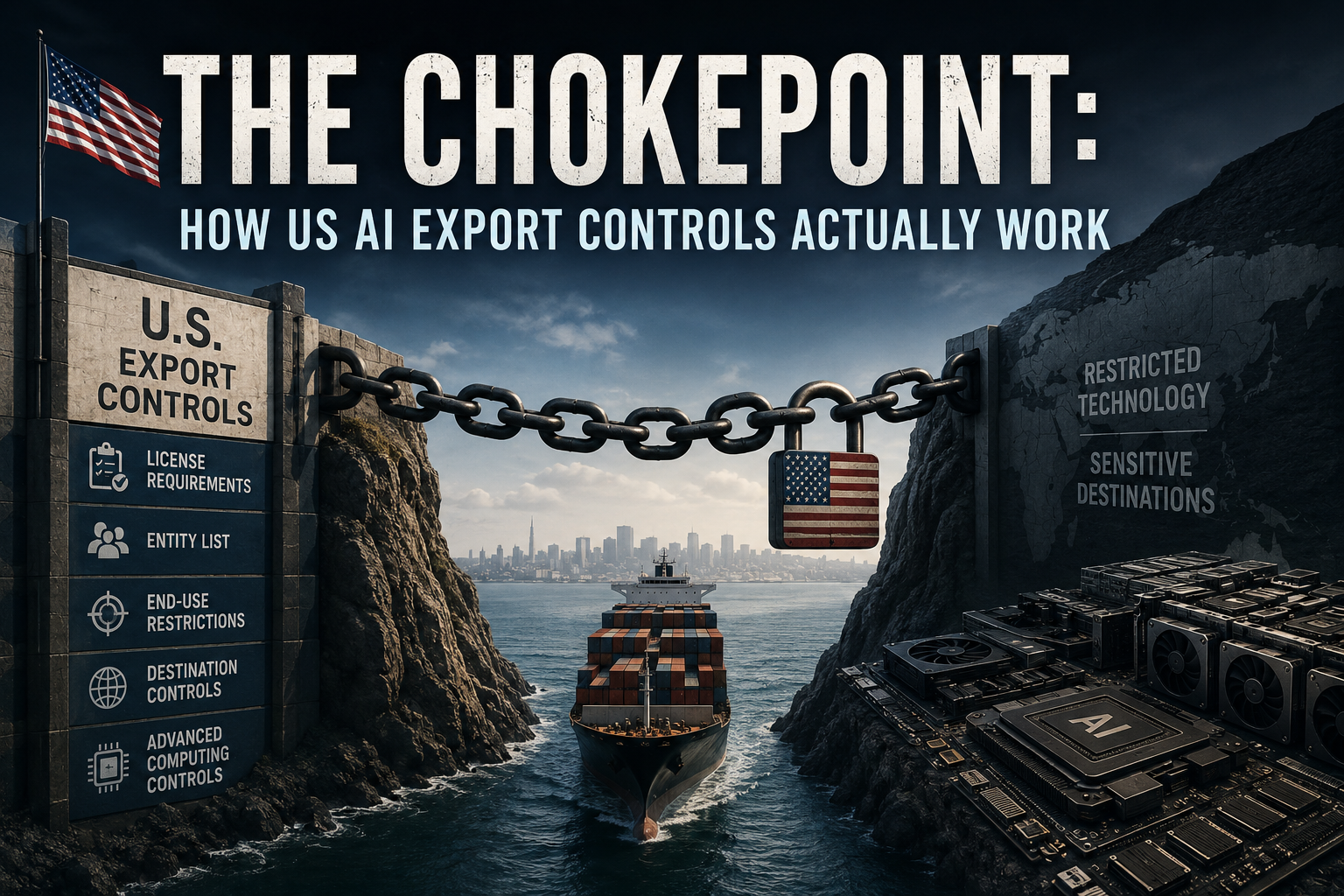
The Chokepoint: How US AI Export Controls Actually Work
The United States has spent four years building export controls around artificial intelligence. But what they actually restrict isn’t what most headlines suggest — and the one rule that tried to control AI models themselves never took effect.
By Syed Umair Ali · 14 min read · Filed under Technology Policy
The short version
- US export controls on AI overwhelmingly target hardware — advanced chips and the equipment to make them — not consumer AI products or chatbots.
- The legal machinery sits with the Commerce Department’s Bureau of Industry and Security (BIS), operating under the Export Administration Regulations.
- The Biden-era AI Diffusion Rule (January 2025) would have been the first to control AI model weights. The Trump administration rescinded it in May 2025, days before it took effect.
- As of 2026, policy is shifting toward case-by-case licensing for some advanced chips, paired with new tariffs — a notably different approach from a blanket ban.
- For most developers outside China, access to commercial AI APIs has remained broadly intact throughout. The fight is upstream, at the silicon.
1. What “export controls” actually means
An export control is a government restriction on which technologies can leave the country, who can receive them, and what they can be used for. In the United States, the core framework for “dual-use” items — things with both civilian and military applications — is the Export Administration Regulations (EAR), administered by the Commerce Department’s Bureau of Industry and Security.
BIS maintains a long list of controlled items, each tagged with an Export Control Classification Number (ECCN). When an item is controlled for a destination, an exporter generally needs a license before shipping it. The government can set the default answer to that license request anywhere along a spectrum: routine approval, case-by-case review, or a “presumption of denial” that effectively functions as a ban.
Key distinction: A “ban” in this world is rarely a single dramatic order. It is usually a licensing posture — the standing instruction BIS gives itself about whether to say yes. Shifting that posture from “presumption of denial” to “case-by-case review” can quietly reopen a market without any headline-grabbing announcement.
The crucial point for understanding AI policy: these controls were built for physical goods and the technology to produce them. Software has always been harder to control, because it copies freely and crosses borders as easily as an email. That tension runs through everything that follows.
2. Why the fight is about chips
Modern AI runs on specialized processors — primarily high-performance GPUs. Training a frontier model requires enormous clusters of them. That physical dependency makes chips a natural chokepoint: restrict the hardware, and you constrain who can train cutting-edge systems, regardless of how freely the resulting software might travel.
Since October 2022, the US has restricted exports of advanced AI chips to China, using performance thresholds — measured in part by a metric called Total Processing Performance (TPP) — to define which processors fall under control. The rules have been revised repeatedly as both the technology and the geopolitics evolved.
One analysis notes that the inputs to a single chip may cross international borders dozens of times before reaching the end customer. The US does not control every link in that chain — which is why officials have repeatedly stressed that controls lose effectiveness unless allies adopt parallel rules.
“When I set the rules, I have to make damn sure China can’t just buy this stuff from Japan or Korea or the Europeans.”
— Then-Commerce Secretary Gina Raimondo, December 2024, as quoted by CSIS
This is why the chip story is also a diplomatic story. A control is only as strong as the narrowest gap in the supply chain, and most of the critical tooling — like the Dutch firm ASML’s extreme-ultraviolet lithography machines — sits outside US borders.
3. The rule that tried to control AI models
For most of this history, the controls stopped at hardware. Then, in its final days, the Biden administration tried to extend them to the software itself.
On January 13, 2025, BIS published the Framework for Artificial Intelligence Diffusion — the “AI Diffusion Rule.” For the first time, it proposed controlling certain closed-source AI model weights, classified under a new ECCN, 4E091, alongside a worldwide licensing framework for advanced computing chips. Model weights are the trained parameters that make a model what it is; controlling them would have meant treating a frontier model’s “brain” as a regulated export.
The rule sorted the world into a tiered system — a small group of close allies with broad access, a restricted group, and adversaries facing the tightest limits. It drew immediate, intense criticism from industry, allied governments, and analysts, who argued it was vague, hard to enforce, extraterritorial in reach, and likely to hurt American competitiveness more than it constrained rivals.
Timeline:
- Jan 13, 2025 — AI Diffusion Rule published as an interim final rule. Effective immediately, but compliance deferred to give industry time to adapt.
- Set for May 15, 2025 — The date on which exporters would have had to comply with the new model-weight and chip licensing requirements.
- May 13, 2025 — Rescinded, two days before it bit. The Trump administration announces it will rescind and replace the rule, instructing BIS not to enforce it, arguing the rule would stifle US innovation and strain relations with allies.
The takeaway that gets lost: The only US rule that ever attempted to place export controls on AI model weights never reached its compliance date. It was withdrawn before exporters were obligated to follow it. As of mid-2026, there is no operative US export control that bans a commercial AI model as such — the controls that remain in force are aimed at chips and chip-making equipment.
When the rule was rescinded, BIS did not leave a vacuum. It issued guidance reverting to the pre-existing rules and warning industry that certain AI-related dealings with adversary states could still trigger violations under existing authorities — for example, where there is reason to know a transaction supports weapons or military-intelligence end uses. So the posture tightened in some respects even as the formal model-weight controls disappeared.
4. Where things stand in 2026
Policy in 2026 has continued to move — and not always toward tighter restriction. In January 2026, BIS published a final rule shifting the review posture for certain advanced AI chips bound for China and Macau from a “presumption of denial” toward case-by-case review, with extensive certification requirements for applicants. One day earlier, the White House announced a 25% tariff on advanced semiconductors meeting the same performance thresholds.
Loosened export licensing paired with a new tariff is a deliberately mixed signal. It uses one trade tool to manage strategic technology flows and another to manage domestic economics — reflecting a shift from blunt prohibition toward a more granular, transactional approach.
By March 2026, news outlets reported that the government was drafting a broader framework that would position the US as a gatekeeper for the global AI chip trade, with the depth of review scaling to the amount of computing power in a given export. As of this writing the draft text was not public, so its details remain reported rather than confirmed.
The arc of US AI export controls, 2022–2026:
| Period | Target | Posture |
|---|---|---|
| Oct 2022 | Advanced chips to China | Restrict |
| Oct 2023 | Revised chip thresholds + end-uses | Tighten |
| Dec 2024 | +140 firms; memory; FDPR expansion | Tighten |
| Jan 2025 | Chips and AI model weights | Proposed |
| May 2025 | AI Diffusion Rule | Rescinded |
| Jan 2026 | Some advanced chips to China/Macau | Case-by-case |
| Jan 2026 | Advanced semiconductors (imports) | 25% tariff |
| Mar 2026 | Broad chip framework (reported) | Drafting |
5. Why governments care
The national-security argument rests on a simple chain of reasoning: frontier AI could confer decisive military, intelligence, and economic advantages; training frontier AI depends on advanced chips; therefore controlling the chips slows a rival’s progress at the most defensible chokepoint. Officials have specifically pointed to risks around weapons of mass destruction and military-intelligence end uses when justifying restrictions on adversary states.
Critics raise several counterarguments worth stating fairly:
- Effectiveness erodes. Unilateral controls leak through third countries unless allies coordinate.
- Innovation costs. Restrictions can cut US firms off from major markets and push rivals to build domestic alternatives faster.
- Diplomatic friction. Extraterritorial rules that reach allied companies strain the very coalitions the controls depend on.
There is no settled consensus here. Reasonable analysts disagree about whether controls have meaningfully slowed rival capabilities or mostly accelerated indigenous chip programs. The honest summary is that the evidence is genuinely contested, and that the policy has oscillated partly because the underlying tradeoffs are hard.
6. What it means for developers
If you build software on top of commercial AI APIs — the situation for most developers, including those across South Asia, the Middle East, and emerging markets — the day-to-day impact of these controls has been limited. The restrictions target the silicon and, briefly, model weights destined for adversary states. They are not a wall between an ordinary developer in Karachi or Nairobi and a commercial AI service.
That said, the policy volatility itself is the risk worth planning around. Rules that change every few months make it unwise to depend on a single provider or a single jurisdiction. The same business-continuity logic that applies to any critical dependency applies here.
Pragmatic resilience for AI-dependent builders:
| Concern | Practical hedge |
|---|---|
| Provider concentration | Abstract your AI calls behind an internal interface so you can swap models without rewriting your app. |
| Regional access shifts | Know which providers operate in your jurisdiction and keep a tested fallback. |
| Open-weight option | For non-frontier needs, open-weight models you can self-host insulate you from access policy entirely. |
| Compliance exposure | If you resell or relocate hardware, understand whether your activity touches controlled ECCNs. |
None of this requires panic. It is ordinary architectural hygiene — the kind that pays off whenever any upstream dependency, regulatory or technical, changes underneath you.
7. The global picture
US controls do not exist in isolation. Because critical tooling is concentrated in a few countries — the Netherlands, Japan, South Korea, Taiwan — Washington’s strategy depends on persuading allies to align their own rules. That coordination has been partial and contested, with allied governments weighing their own commercial interests against US security arguments.
For everyone else, the controls have accelerated a broader conversation about AI sovereignty: the idea that nations want some degree of independent capability rather than total reliance on technology that a foreign government can restrict. That impulse is visible in regional cloud investments, domestic chip ambitions, and growing interest in open-weight models that no single jurisdiction can switch off.
The likeliest near-term trajectory is not a binary of “open” versus “closed,” but a fragmenting map — different access tiers, different licensing burdens, and a growing premium on options that route around any single point of control.
8. Frequently asked questions
Do US export controls ban specific AI chatbots or apps?
No. The controls target advanced chips and chip-making equipment, and briefly proposed controlling AI model weights before that rule was withdrawn. They are not a list of banned consumer products.
What is BIS?
The Bureau of Industry and Security, part of the US Commerce Department. It administers the Export Administration Regulations and decides which dual-use technologies require a license to export.
What were AI “model weights” doing in an export rule?
The January 2025 AI Diffusion Rule proposed treating certain closed-source model weights as a controlled export under a new classification (ECCN 4E091). It was the first attempt to regulate the trained model itself rather than the hardware. It was rescinded before it took effect.
Is the AI Diffusion Rule still in force?
No. The Trump administration announced its rescission on May 13, 2025, two days before the compliance date, and instructed BIS not to enforce it.
What replaced it?
Initially, interim guidance reverting to the prior rules plus enforcement warnings. Through 2026, BIS issued further rules adjusting chip licensing and the administration added tariffs, with a broader framework reported to be in drafting.
What is “presumption of denial”?
A licensing posture in which BIS’s default answer to an export-license application is “no.” It functions as a near-ban without being phrased as one.
What changed in January 2026?
BIS shifted the review posture for certain advanced chips to China and Macau from presumption of denial toward case-by-case review, while the White House added a 25% tariff on comparable semiconductors.
Why are chips the focus rather than software?
Software copies and crosses borders freely, making it hard to control. Chips are physical, concentrated in a few supply chains, and essential to training frontier models — a far more defensible chokepoint.
What is TPP?
Total Processing Performance, a metric BIS uses to define which processors are powerful enough to fall under control.
Why do allies matter so much?
Key tooling, such as advanced lithography machines, is made outside the US. Without allied cooperation, restricted buyers could source equivalent technology elsewhere.
Does this affect developers outside the US?
For those using commercial AI APIs, generally not directly. The controls operate upstream at the hardware level and target specific adversary destinations.
What is the Entity List?
A BIS list of organizations subject to specific license requirements. Being added typically means exporters need a license — often presumptively denied — to supply that entity.
Are these controls proven to work?
It’s contested. Supporters argue they slow rival capabilities at the chokepoint; critics argue they leak through third countries and accelerate domestic alternatives. The evidence is genuinely mixed.
What is AI sovereignty?
The goal of having enough independent AI capability — chips, compute, or models — that a nation isn’t fully dependent on technology a foreign government could restrict.
Do open-weight models avoid all this?
Largely, for the user. A model you can download and self-host isn’t subject to a provider’s access policy — though the hardware to train such models at the frontier remains controlled.
Where can I read the primary sources?
BIS publishes rules in the Federal Register; law-firm client alerts and think-tank analyses (such as CSIS) track changes closely.
9. Key takeaways
- US AI export controls are, in practice, chip controls — aimed at hardware and the tools to make it.
- The single attempt to control AI model weights — the 2025 AI Diffusion Rule — was rescinded before its compliance date.
- “Bans” usually take the form of a licensing posture, which can tighten or loosen without dramatic announcements.
- 2026 has trended toward case-by-case review and tariffs rather than blanket prohibition, with a broader framework reportedly in drafting.
- Controls depend on allied coordination; the supply chain’s weakest link sets the ceiling on their effectiveness.
- For most developers, commercial AI access has stayed open — but provider diversification is sensible insurance against policy volatility.
Editorial note: This article is an explainer based on public reporting and primary regulatory sources as of June 16, 2026. Where information was reported but not officially confirmed — such as draft regulations not yet published — it is identified as such. Export-control regulations change frequently; verify current rules against the Federal Register and BIS guidance before making compliance decisions. This is general information, not legal advice.